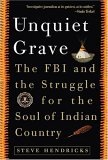

The Unquiet Grave, by Steve Hendricks.
[rating:5/5]
This is a book I could not put down. The historic, though mostly unknown events on the Pine Ridge Reservation from the 1970s are so over-the-top that you have a hard time believing it all really happened. And it was only 30 years ago. American Indians (AIM) picked up guns and began to assert their rights. The FBI and other government agencies fought back, eventually all but destroying the American Indian Movement.
Hendricks illuminates these events for the battles they were, as he builds the case against the FBI and the Establishment’s COINTELPRO response to what started out as simple activism. Hendricks makes the case that the FBI’s actions to undermine the American Indian Movement pretty much caused the situation to blow up into horrific violence carried out on all sides. Just like a fearful government undermined Marcus Garvey, Martin Luther King, the Black Panthers, etc. You are left wondering what history would have been like if J. Edgar Hoover hadn’t been such a prick.
As the story goes from shootout to shootout, murder to murder, trial to trial, Hendricks peels layers and layers from each story in a grasp for the truth underneath. Many times, after hearing all the conflicting witness accounts to an event, we are left to wonder what really happened and which side had the worst set of bad guys (it seems that everyone was shady and that there weren’t many good guys on either side of the fight).
You can’t help but get caught up in the gossip, the theories of who killed who, the bumbling of the FBI and the judicial system. And you can’t believe how crazy the whole situation is.
I normally quote a few short passages from books, but here’s one longer excerpt from The Unquiet Grave:
The goons gave chase. When DeSersa noticed them in his rearview mirror, he flattened the accelerator of his Grand Prix until he was driving eighty-five or ninety miles an hour, but his lead nonetheless melted steadily. at an S-curve a mile out of Wanblee, his transmission jammed in fourth gear, and by the time he got it unstalled, the first goon car, a large black sedan, had pulled alongside him.
“Get down!” someone in DeSersa’s car shouted.
An instant later a gun roared from the black sedan. Three or four more shots followed in quick succession, and glass and metal exploded throughout the cabin of the Grand Prix. A cloud of smoke and debris swirled around everything.
“Oh Christ, man, I’m hit!” DeSersa screamed. “I’m hit bad!”
George Bettelyoun, sitting behind DeSersa, told him to stop the car.
“I can’t,” DeSersa said. He was in tears. “I’m hit bad.”
Lester Jack, sitting in the front passenger seat, urged DeSersa not to loser control, and this much DeSersa was able to do for his passengers. He kept the Grand Prix in its lane until it slowed of its own accord and coasted into the roadside ditch.
George Bettelyoun later said, “The black car that shot us up went past us and stopped. I was thinking they were going to come back and start shooting again. The other guys in our car, they got out and started running up the bank on the side of the road. I tried to get Byron out, but he said, ‘I can’t move. My leg-.’ So I looked over the seat, and his leg was almost blew off. There was a hole in there right through the center. So I said, ‘Get out. They’re gonna kill you.’ I knew they weren’t shooting the play around after I seen that hole in his leg. So he crawled across the seat and got out the door, and I tried to help him up that bank. But he couldn’t make it. He said, ‘Go on.’ So I just took off. It was all open country there. There’s no cover whatsoever, just a fence line that the weeds are piled up on.
The Unquiet Grave, by Steve Hendricks.
[rating:5/5]